For many small and medium-sized businesses, cybersecurity still feels like something that mainly concerns large enterprises, banks, or government organisations. Unfortunately, cybercriminals no longer see it that way. SMEs are now among the most frequently targeted organisations, not because they are weak, but because they are often easier to compromise and deeply connected to larger digital supply chains.
Today, even a relatively small business relies on cloud platforms, remote working tools, online payments, customer databases, and third-party software providers to operate day to day. That digital dependence creates opportunity but also exposure. A single phishing email, stolen password, or vulnerable device can quickly turn into operational disruption, financial loss, reputational damage, or even a supply chain incident affecting customers and partners.
And the threat landscape is intensifying. According to the ENISA Threat Landscape 2025 report1, ransomware remains one of the most significant cybersecurity threats facing European organisations, with attackers increasingly targeting operational disruption, supply chains, and data exfiltration simultaneously. The report also highlights a growing level of sophistication in cyberattacks, including the use of AI-enhanced phishing, credential theft, and multi-stage attacks designed to bypass traditional security controls. SMEs remain particularly exposed because they often lack continuous monitoring capabilities, specialised cybersecurity personnel, and the operational maturity required to detect and respond to threats quickly.
Recent attacks also demonstrate that disruption can affect organisations of any size and sector. Retailers, manufacturers, airports, and public authorities across Europe have all experienced operational disruption caused by ransomware attacks over the past year. The cyberattack affecting airport systems linked to Collins Aerospace disrupted check-in and baggage operations across multiple European airports, while attacks against retailers and industrial organisations have caused millions in losses and prolonged service outages. For SMEs, incidents like these are particularly concerning because smaller organisations often lack the resources to absorb prolonged downtime or recover quickly after an attack.
At the same time, regulatory expectations continue to grow. Frameworks such as NIS2 are increasing the focus on cybersecurity and operational resilience across European supply chains, including organisations that may previously have considered themselves outside the scope of cybersecurity regulation. Customers, insurers, and business partners are also becoming more cautious, increasingly expecting organisations to demonstrate that they take cybersecurity seriously.
The challenge is that most SMEs simply do not have the resources to build and operate an internal Security Operations Centre (SOC). Running a modern SOC requires continuous monitoring, specialised cybersecurity expertise, threat intelligence capabilities, incident response procedures, and the ability to manage large volumes of alerts and security data. For many smaller organisations, that level of investment is unrealistic.
As a result, cybersecurity often becomes reactive. Businesses invest in security tools over time, usually in response to customer requirements, compliance demands, or incidents that have already happened. But disconnected tools without continuous monitoring rarely provide the visibility or response speed needed against modern cyber threats. Even organisations with good intentions can struggle to keep up with the pace and sophistication of today’s attacks. This is where SOC-as-a-Service is changing the conversation.
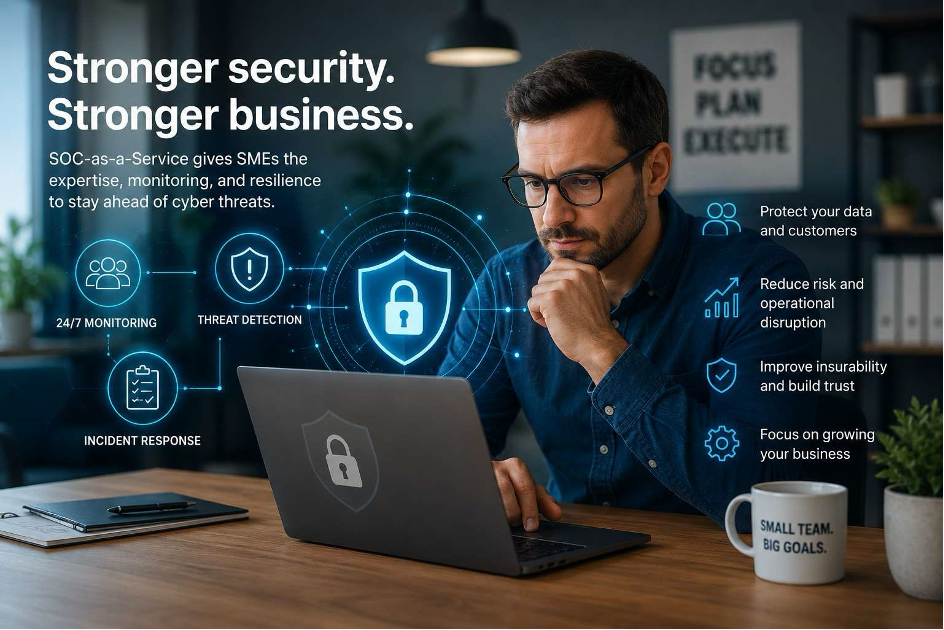
Rather than requiring SMEs to build a complete security operations capability internally, SOC-as-a-Service gives organisations access to advanced cybersecurity expertise and technologies through a managed service model. In practical terms, this means businesses can benefit from continuous monitoring, threat detection, vulnerability management, incident response support, and threat intelligence without maintaining a large in-house cybersecurity team.
More importantly, modern SOC services are becoming increasingly intelligent. AI- assisted threat detection, behavioural analytics, automated response workflows, and real-time risk visibility are helping organisations identify suspicious activity earlier and respond more effectively. Instead of discovering incidents only after damage has occurred, businesses can move towards a more proactive and resilient security posture. The iSOCaaS approach, for example, focuses specifically on delivering intelligent managed SOC services tailored to organisations with different levels of cybersecurity maturity, including SMEs.
There is also an important business dimension to this shift. Cyber insurance providers are increasingly looking beyond static annual questionnaires and paying closer attention to an organisation’s operational cybersecurity maturity. Continuous monitoring, documented response capabilities, and measurable security controls can all contribute to stronger cyber resilience and improved insurability. In other words, cybersecurity is no longer just a technical issue, it is becoming part of overall business risk management.
For SMEs, this matters because operational resilience has become directly linked to trust. Customers want confidence that their data is protected. Partners want reassurance that supply chain risks are being managed responsibly. Regulators expect organisations to take reasonable cybersecurity measures. And business leaders increasingly understand that cyber incidents can affect operations just as seriously as financial or physical disruptions.
Cybersecurity will always remain a challenge, especially as threats continue to evolve. But SMEs do not need to face that challenge alone or build enterprise-scale security operations from scratch. SOC-as-a-Service offers a more practical path forward, one that gives organisations access to the visibility, expertise, and resilience they need to operate confidently in an increasingly digital and interconnected world.